Keith Johnstone
Spontaneity, status, accepting offers and reducing the fear of being wrong. Johnstone’s status work is particularly relevant to interaction, power and nonverbal behaviour.
 ListenAdapt
APPLIED IMPROVISATION
Improvisation is the art of responding to what is happening here and now. Applied improvisation takes principles, exercises and techniques from improvisational theatre and acting, and uses them as practical learning tools for leadership, collaboration and professional development.
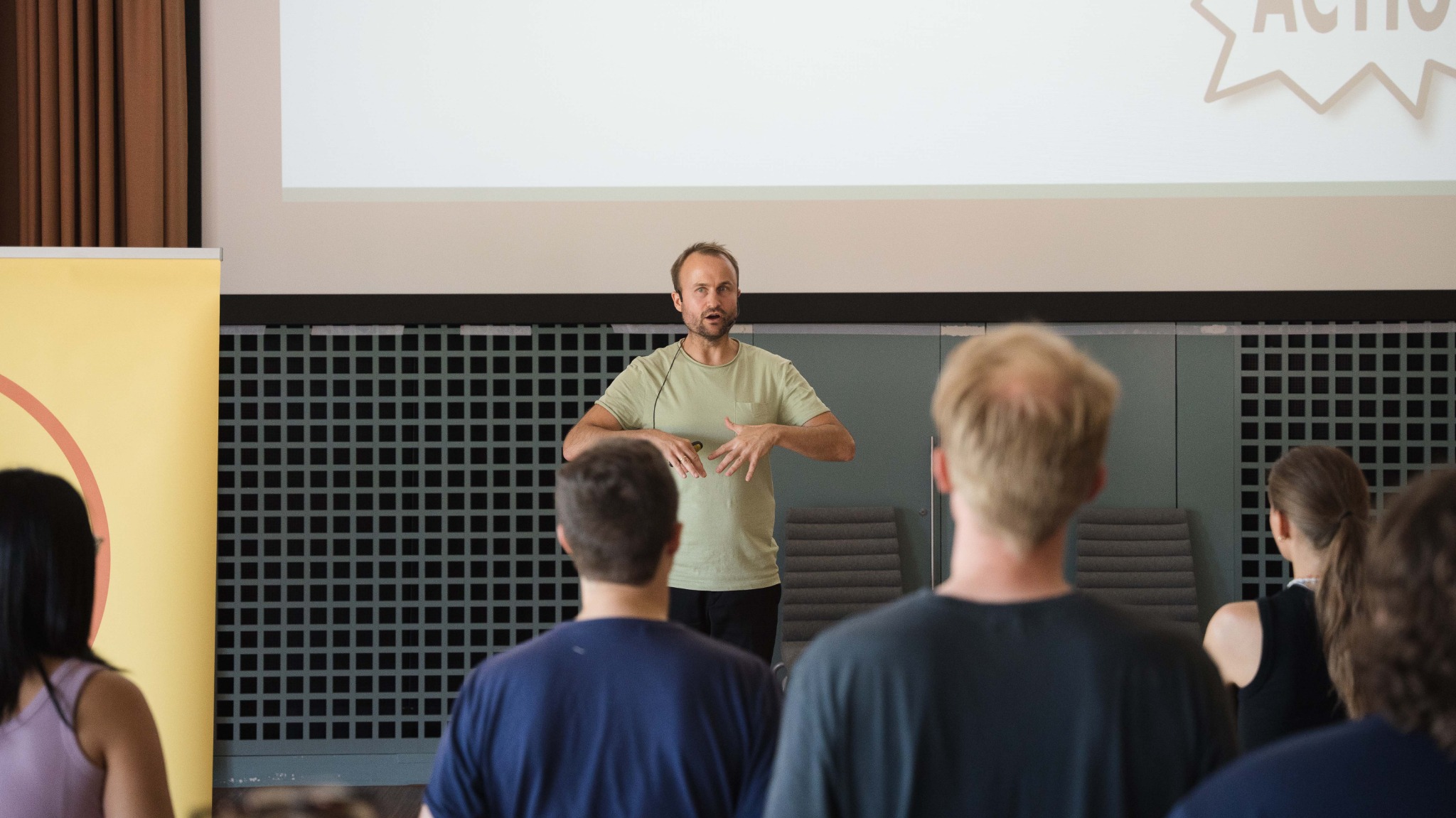
DESIGNED FOR PEOPLE, NOT PERFORMERS
“Marius made every exercise feel safe and approachable.”
Stine · SustEvo AS
“Thank you for a different and playful experience. It exceeded all expectations.”
Vegard · HRP
“You get to know colleagues differently and step outside your comfort zone. A team-building activity with lots of laughter that I would recommend.”
Aleksander · Meta
WHAT IS IMPROVISATION?
In improvisational theatre, performers work without a predetermined script. They listen, notice, make offers, respond to one another and build something together in real time.
That requires more than quick thinking. Good improvisation depends on attention, acceptance, flexibility, presence and the ability to respond to changing information. Applied improvisation takes these practical principles beyond the theatre.
SIX VOICES THAT SHAPE THE WORK
Spontaneity, status, accepting offers and reducing the fear of being wrong. Johnstone’s status work is particularly relevant to interaction, power and nonverbal behaviour.
Attention, listening and truthful response. Meisner’s outward focus directs attention towards the partner, the relationship and what is changing in the moment.
Action, intention and embodied behaviour. His work connects circumstances and objectives with what performers actually do with voice, movement and attention.
A contemporary bridge from improvisation into everyday work: pausing, noticing, responding to circumstances and working productively with uncertainty.
A major voice in articulating Applied Improvisation as a field of practice beyond performance, connecting improvisational methods with organisations, education and development.
Co-editor with Dudeck of Applied Improvisation: Leading, Collaborating, and Creating Beyond the Theatre, documenting applications across professional contexts.

FROM THEATRE TO PRACTICE
In theatre, an exercise might help performers create a scene, become more spontaneous or connect more closely with a partner. In Applied Improvisation, the same exercise can become a way to explore listening, collaboration, uncertainty, presence and adaptability.
ACTING TECHNIQUES BEYOND IMPROVISATION
Not every exercise used by ListenAdapt comes from improvisational theatre alone. Some move into actor training, including work with observation, repetition, physical behaviour, character, status, intention and relational response.
Marius’ background includes improvisation, Method Acting and Chubbuck-based training. These traditions offer practical ways to work with presence, attention, intention and embodied behaviour.
The objective is not to teach acting technique for its own sake, but to borrow useful training methods from environments where people have spent generations studying human interaction.
Participants enter practical situations before analysing them. Behaviour becomes observable because something is actually happening between people.
Participants do not need to become good improvisers. The exercises are tools: their value lies in what people notice and what they can transfer into meetings, leadership, collaboration and communication.
WHAT CAN APPLIED IMPROVISATION DEVELOP?
Many of these capabilities are often described as 21st Century Skills or soft skills: communication, collaboration, creativity, adaptability and social awareness. Applied improvisation turns these broad concepts into practical situations where they can be experienced, noticed and rehearsed.
Stay with what is happening, notice other people and respond with greater attention.
Psychological Safety →Build on contributions, work with mistakes and create more room for participation and constructive risk-taking.
Innovation & Creativity →Generate possibilities, tolerate uncertainty and adjust when information or circumstances change.
Body Language →Explore how these capabilities connect to ListenAdapt’s workshops in psychological safety, innovation & creativity and body language.
RESEARCH, PRACTICE & A LIVING TRADITION
ListenAdapt draws on longstanding traditions in actor training and improvisational theatre, a contemporary international field of Applied Improvisation, and research into embodied learning, nonverbal behaviour and professional development.
Marius’ own research examines Applied Improvisation, embodied learning, nonverbal behaviour, power dynamics and how experiential learning can transfer into professional contexts.
View Marius’ research profile →FREQUENTLY ASKED QUESTIONS
No. Applied Improvisation borrows exercises and principles from improvisational theatre but uses them for learning and development outside performance.
Usually not in the theatrical sense. Exercises are designed around learning, interaction and experimentation rather than entertainment.
No. The work is designed for people without performance experience, and exercises are introduced gradually.
Actor training offers practical methods for working with attention, listening, presence, behaviour and response—capabilities that also matter in professional interaction.
Yes. Applied Improvisation is studied in areas including education, professional learning, creativity and interpersonal development. ListenAdapt also connects this field with research on embodied learning and nonverbal behaviour.
FROM STAGE PRACTICE TO PROFESSIONAL PRACTICE
ListenAdapt adapts exercises from improvisation, actor training and experiential learning to the situations your people actually face.
Discuss your challenge