Embrace mistakes
Experience how a colleague responds when something goes wrong, and what makes it easier to keep trying.
 ListenAdapt
CLIENT CASE · NORWEGIAN ENVIRONMENT AGENCY
How do you make psychological safety, feedback culture and communication practical for around 120 employees at the same time? The Norwegian Environment Agency used applied improvisation as a training environment for exactly that challenge.

WHAT THE CLIENT SAID
“They thought it was going to be really scary and embarrassing … but they found it fun, and it helped build relationships across the section.”
“The short pieces of theory throughout worked really well.”
THE CHALLENGE
The collaboration began with a workshop for the leadership team. They explored practical exercises around nonverbal communication, power and status, feedback and psychological safety. The first session also worked as a pilot: a way to test what felt useful before designing something for a much larger group.
The need became clearer afterwards. The Norwegian Environment Agency wanted to strengthen feedback culture, relationships and awareness of communication, and especially the receiving side of communication. It is one thing to invite questions, disagreement and honest feedback. It is another to notice how we actually respond when someone offers it.
WHAT THE WORKSHOP MADE PRACTICAL
Experience how a colleague responds when something goes wrong, and what makes it easier to keep trying.
Build a response on what the other person actually said, rather than preparing your own contribution too early.
Notice whether your response makes it easier or harder for colleagues to question, disagree or offer unfinished ideas.
Experiment with gaze, voice, distance, posture and use of space, then discuss how those choices affected the interaction.
Use a shared experience to talk about interpersonal risk, feedback, status and communication without making the discussion abstract.
Connect what happened in the exercise to meetings, feedback conversations and other situations where people need to speak honestly.
FROM PILOT TO 120 EMPLOYEES
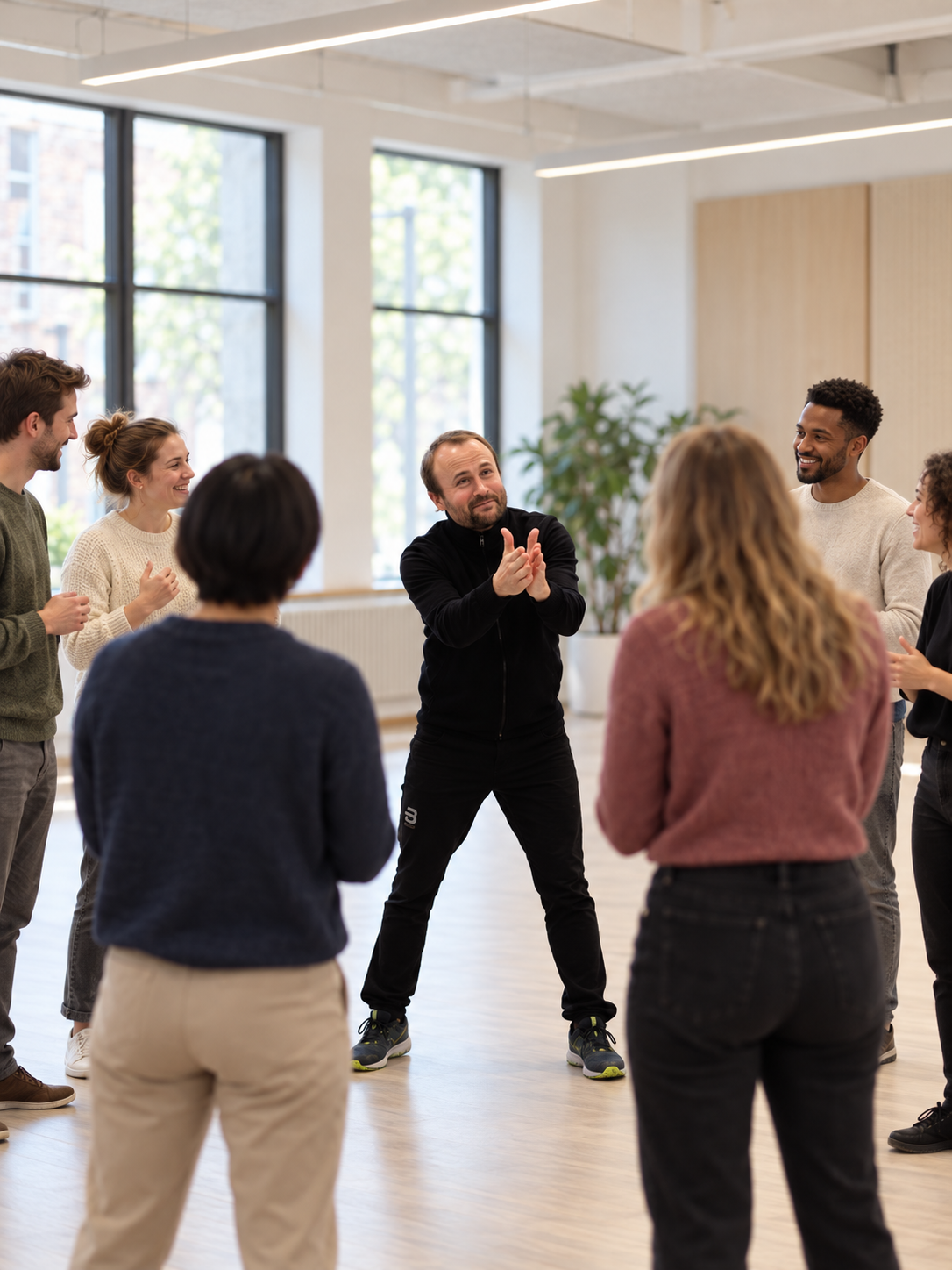
A large improvisation-based session can sound intimidating. The design therefore prioritised simultaneous pair work, clear framing and low-threshold participation. Almost everyone was active at the same time, without individuals being singled out to perform in front of the room.
DESIGN PRINCIPLE
The aim was to create useful interpersonal risk, not performance anxiety. The exercises needed to feel unfamiliar enough to reveal habits, while remaining safe enough for people to stay curious and participate.
Most activities happened in pairs, with the whole room working simultaneously. Nobody had to be brought on stage in front of 120 colleagues to ‘do improv’.
Short, playful exercises were combined with reflection and small pieces of theory. Participants first had an experience; only then did the group examine what had happened.
That sequence makes communication observable. Instead of discussing listening, feedback or psychological safety only as concepts, participants can notice what they did, how another person responded and what they might try differently.
The client highlighted both the relational value of the exercises and the usefulness of connecting practical experiences to concise theoretical framing.
WHAT WE PRACTISED
The workshop focused on situations participants could experience directly, discuss with a colleague and connect back to everyday work.
Pairs completed a simple coordination task that quickly became harder than it sounded. The point was not to avoid mistakes, but to notice what happened between two people after one occurred.
Participants practised building responses on what their partner had actually said—from catching individual words to responding to the meaning of the contribution.
Participants experimented with gaze, voice, distance, posture and use of space, then discussed what they observed, how it affected them and what they wanted to do in response.
Psychological safety became something participants could feel, observe and discuss—not only a concept presented on a slide.
THEORY IN SMALL DOSES
Rather than opening with a long lecture, theory was introduced in short segments between activities. The group could therefore use what they had just experienced to discuss psychological safety, interpersonal risk, listening, body language and relational communication.
This makes theory more concrete: participants already have a shared situation to refer to when they ask what made an interaction feel open, defensive, supportive or difficult.
Explore Psychological Safety workshops →START A CONVERSATION
Tell Marius what your leaders or teams need to practise. He will suggest a format built around your people, context and challenge.
Discuss your challenge